AMAAS began with a simple question: instead of asking, “What stock do I like?”, what happens if we evaluate a broad market universe consistently and ask, “What does the data tell us?”
That question gradually expanded beyond screening. As the platform developed, the problem became less about producing another ranking and more about connecting the parts of an investment-research process. Quantitative ranking led to company research. Company research led to comparison. Comparison led to portfolio construction. Portfolios created a need for market benchmarks and persistent baselines. Accountability created a need to preserve what the system knew at a particular moment rather than quietly replacing yesterday’s evidence with today’s data. Natural-language interaction and a growing financial Knowledge Base then made it possible to connect those capabilities through a more intuitive human-machine interface.
The result is AMAAS—American Market Analysis as a Service—and this book documents the ideas, experiments, corrections, and design decisions that shaped it.
A Partnership, Not a Substitute for Judgment
The central idea of this book is not that technology should replace investment judgment. It is that people and machines bring different strengths to the research process.
Machines are particularly good at organizing large amounts of data, repeating calculations consistently, preserving evidence, comparing thousands of observations, and retrieving prior analytical states. People remain essential for defining objectives, questioning assumptions, interpreting context, deciding which risks matter, and determining what action—if any—should follow from the evidence.
AMAAS was built around that division of labor. The machine can expand what we are able to see. The human being remains responsible for deciding what it means.
Learning by Building
Some of the most useful lessons in the development of AMAAS came from things that did not work exactly as expected. A ranking that looked reasonable raised a better question about what the ranking actually represented. A mobile interface exposed an architectural weakness. Measuring an earlier forecast forced greater precision about time, baselines, and the difference between updating an analysis and rewriting its history.
Each correction improved more than the software. It improved our understanding of the investment workflow itself.
That became a recurring discipline throughout the project: build, observe, measure, correct, and keep the evidence. Models can change. Interfaces can change. Data sources can change. But if the analytical history is preserved, the system can learn without pretending that the past looked different than it actually did.
Ecosystem, Not a Replacement
Investment professionals already work with a wide range of analytical technologies, data services, research methods, and proprietary processes. AMAAS was not designed on the assumption that those tools should be replaced. Its role is complementary: to add another analytical perspective, organize evidence across a broad equity universe, preserve the state of an analysis over time, and connect research more naturally with comparison, selection, and portfolio evaluation.
Financial analysis rarely depends on a single instrument. Different tools can examine the same market from different directions, much as different instruments in a laboratory measure different properties of the same subject. The value often comes not from choosing one and discarding the others, but from understanding how their observations fit together.
Our collaboration with VantagePoint AI provides a timely example. VantagePoint brings its own approach to predictive market analysis and identifying potential changes in market direction. AMAAS approaches the investment process from another direction—combining a broad analytical universe with relative ranking, historical evidence, continuous updating, and accountability for what happens after an observation or selection is made.
These approaches contribute different information to the same investment workflow.
That is increasingly how I think about the future of financial technology: not one enormous system attempting to replace everything that came before it, but an ecosystem of specialized analytical capabilities that can work together. APIs, shared data, and increasingly capable human-machine interfaces can make it easier to bring those different perspectives together while allowing investors and professionals to retain the tools and sources they already trust.
The objective is not to replace the investment professional—or the professional’s existing toolbox. It is to make the toolbox a little more connected, a little more measurable, and perhaps a little more useful.
What This Book Explores
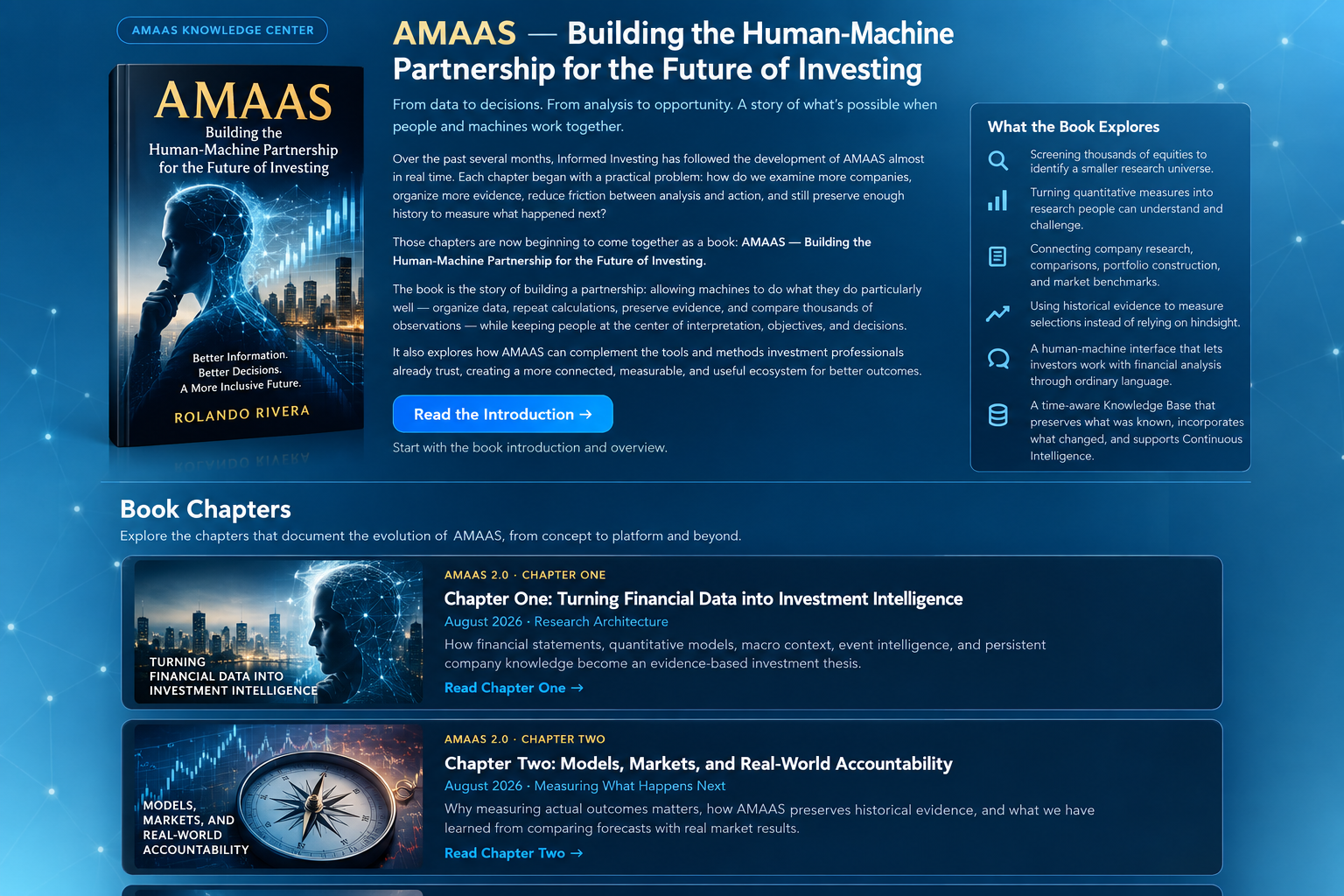
- Screening thousands of equities to identify a smaller research universe worthy of deeper attention.
- Turning quantitative measures into research that people can understand, question, and challenge.
- Connecting company research, comparisons, portfolio construction, and market benchmarks.
- Using historical evidence to measure selections rather than relying on hindsight.
- Designing a human-machine interface that allows investors to work with financial analysis through ordinary language.
- Building a time-aware Knowledge Base that can preserve what was known, incorporate what changed, and support Continuous Intelligence.
- Connecting specialized analytical tools and external evidence without surrendering independent judgment.
Where the Story Is Going
Each step forward introduced more questions. How should evidence be organized? How do we know whether a selection was good? What should remain fixed so yesterday’s analysis can be measured against tomorrow’s market? How can new information improve the analysis without quietly rewriting its history?
Those questions gradually changed the project. What began as an exercise in financial analysis became an exploration of the relationship between data, time, technology, and human judgment.
This is not a story about finding a perfect model, because markets probably have little interest in cooperating with such an ambition. Nor is it an argument that machines should make our decisions for us. It is about building better ways for people and machines to observe, remember, compare, question, and learn together.
Technology will continue to change. Models will evolve. New sources of intelligence will join the process, including tools we have not yet imagined.
Use the machine to expand what we can see. Use evidence to challenge what we think we know. Preserve enough history to learn from what happens next. And keep the human being at the center of the decision.