
Macro Risk and Portfolio Intelligence
Macro Risk Belongs in the Portfolio Conversation
One of the most important lessons in building AMAAS has come from a simple challenge: a good company is not necessarily a good investment under every economic condition.
Chapter One described how AMAAS evolved from a collection of quantitative metrics into an evidence-based investment thesis. Chapter Two addressed a different problem: trust. Predictions should be preserved, tested against subsequent market evidence, and judged by their actual results.
Chapter Three extends that philosophy beyond the individual company.
What happens when the company analysis is favorable, but the economic environment is not?
That question became more important after feedback from readers of Chapter Two. In particular, economist and financial professional Errold Moody, PhD, MBA, LLB, MSFP, BSCE, challenged us to ensure that macroeconomics was not treated merely as another company-level variable.
That observation helped sharpen an architectural distinction already emerging inside AMAAS: the quality of an individual company and the level of systemic economic risk are related, but they are not the same thing.
Two Different Questions
Question One: Is this an attractive company? AMAAS evaluates company-specific evidence including expected return, valuation, financial quality, solvency, sentiment, probabilistic price forecasts, forecast confidence, market behavior, and other quantitative factors.
Question Two: What kind of economic environment surrounds this investment? Interest rates, inflation, economic growth, employment, credit conditions, asset valuations, and the yield curve can affect many securities at the same time.
A company may therefore have strong company-level evidence while systemic economic risk remains elevated. Those statements are not contradictory.
The Investment Score Remains a Company Score
AMAAS does not automatically reduce a company’s Investment Score because the macroeconomic environment is classified as elevated risk. Instead, AMAAS preserves both observations.
Company evidence: Investment Score and thesis.
Systemic evidence: Macroeconomic Risk & Portfolio Context.
The investor or financial professional can see both rather than having one opaque number conceal the disagreement.
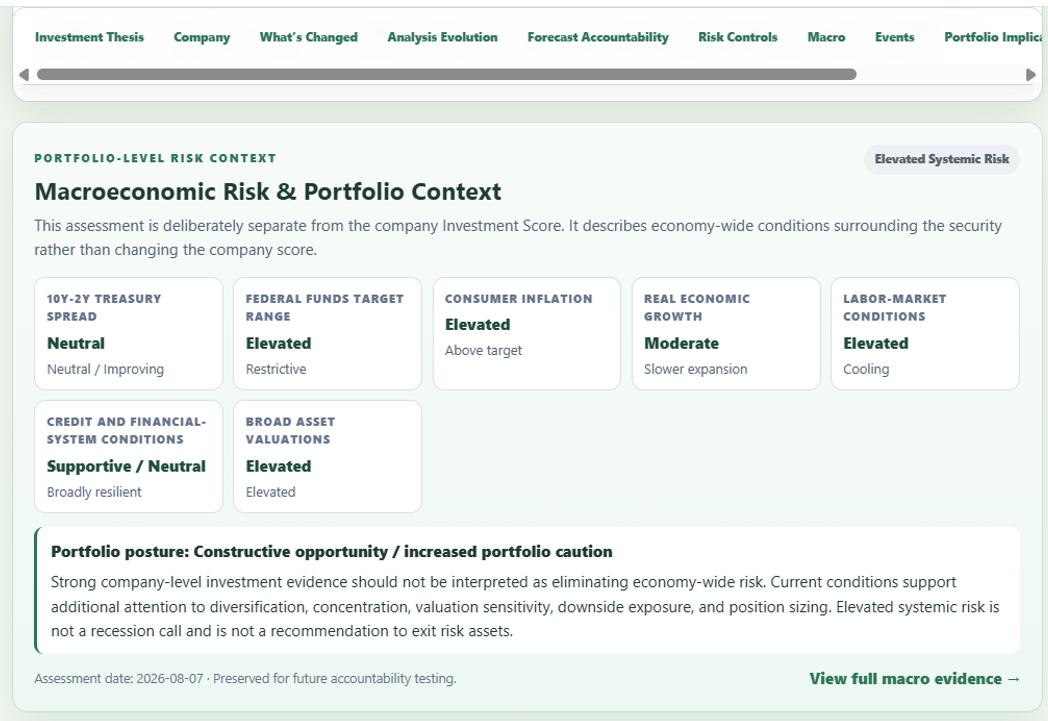
The Seven Systemic Evidence Categories
| Macro factor | What AMAAS is asking |
|---|---|
| 10Y–2Y Treasury Spread | What is the yield curve telling us about monetary conditions and recession risk? |
| Federal Funds Target Range | Is monetary policy accommodative, neutral, or restrictive? |
| Consumer Inflation | Is inflation sufficiently controlled, or does it continue to create policy and valuation pressure? |
| Real Economic Growth | Is the economy expanding, slowing, or contracting? |
| Labor-Market Conditions | Is employment supporting continued expansion, or is material weakness developing? |
| Credit & Financial-System Conditions | Is financing broadly available, or is systemic financial stress developing? |
| Broad Asset Valuations | Are investors paying historically elevated prices across major asset classes? |
The Yield Curve: Signal, Not Stopwatch
Reader feedback emphasized the historical importance of an inverted Treasury yield curve. But even an important signal does not tell us precisely when a recession will begin, how severe it will be, how long it will last, or how an individual security will behave during the intervening period.
AMAAS therefore treats macro evidence as context, not as a mechanical market-timing command.
From Macro Forecasting to Portfolio Implications
The first AMAAS assessment, dated August 7, 2026, classified the environment as Elevated Systemic Risk while describing the portfolio posture as Constructive opportunity / increased portfolio caution.
Those ideas can coexist. AMAAS may continue identifying individual companies with attractive characteristics while recognizing that broader conditions justify more attention to diversification, concentration, valuation sensitivity, downside exposure, and position sizing.
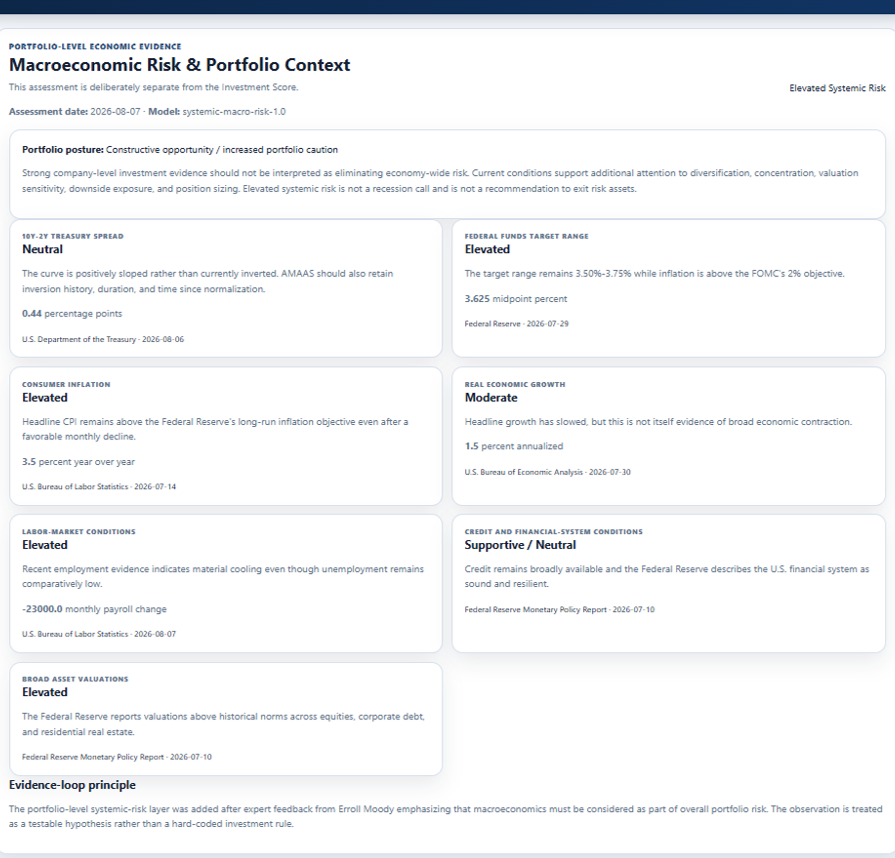
How Users Should Interpret the Panel
The macro panel should be interpreted as a risk overlay, not as another stock-selection score. If AMAAS identifies a strong company while systemic risk is elevated, the appropriate response is not automatically to reject the company.
Instead, the macro assessment should encourage questions about diversification, concentration, shared economic sensitivity, valuation, interest-rate exposure, downside assumptions, liquidity, and position sizing.
Company Risk and Systemic Risk Can Disagree
| Company evidence | Macro environment | Interpretation |
|---|---|---|
| Strong | Supportive | Opportunity with favorable surrounding conditions. |
| Strong | Elevated Risk | Opportunity remains, but portfolio caution increases. |
| Weak | Supportive | Good economic conditions do not repair poor company fundamentals. |
| Weak | Elevated Risk | Both company and systemic evidence warrant greater scrutiny. |
Evidence Must Be Preserved Here Too
The accountability philosophy introduced in Chapter Two applies equally to macroeconomic analysis. Each assessment is dated, versioned, evidence-backed, and preserved rather than overwritten.
Over time, AMAAS can test whether elevated systemic-risk periods were actually associated with greater volatility, deeper drawdowns, different sector behavior, lower win rates, or changes in the right-tail return behavior observed in AMAAS portfolios.
Expert Opinion Becomes a Hypothesis
Expert insight becomes a hypothesis that AMAAS can preserve and test.
Instead of inserting an arbitrary macro penalty into the Investment Score, AMAAS created an independent evidence layer. Its usefulness can now be evaluated empirically.
Acknowledgment. AMAAS development benefits from readers who challenge assumptions and share professional experience. In particular, comments from Errold Moody following Chapter Two helped sharpen the distinction between company-level economic sensitivity and portfolio-level systemic macroeconomic risk. His observation that macroeconomics must remain part of overall risk helped motivate the feature described in this chapter. The implementation is AMAAS’s own, and its usefulness will ultimately be determined by evidence rather than authority.
Readers Are Becoming Part of the Development Process
These chapters are no longer merely documenting completed software. We publish an idea. Financial professionals, technologists, economists, and investors challenge it. Useful observations become testable features. Those features produce evidence, and that evidence informs the next generation of the platform.
AI Analysis. Human Judgment.
A company can be attractive while the economy is risky. A forecast can be compelling while uncertainty remains high. An economic warning can deserve attention without justifying panic.
Intelligence evaluates the opportunity.
Accountability tests the prediction.
Macro context reminds us that no investment exists in isolation.
Ultimately, the portfolio is where all three meet.
For informational and educational purposes only. AMAAS research, scores, forecasts, macroeconomic assessments, and portfolio observations are analytical tools and do not constitute personalized investment advice, a recommendation to buy or sell any security, or a guarantee of future performance.