A small gesture became a satisfying moment. I opened the AMAAS Top 100 on my iPhone. The list on the screen reflected yesterday’s analytical state. I swiped down. The companies changed. An application update had not been installed. There was no manual rebuilding of the Top 100 equities. The companies changed because the server completed another analytical cycle and delivered a newer view of the market. That small gesture—a finger moving down a piece of glass—represented a surprisingly large shift in data architecture. AMAAS had begun to acquire continuity. Not intelligence in the human sense. Not a machine mysteriously thinking while nobody is watching. Something much more useful.
The system could preserve what it knew yesterday, observe what changed today, and incorporate those changes into its analytical state. The newer state is then available to every interface that depends upon it.
Preserving state in the database enables the application layer to adapt by incorporating new information and recalculating the analytical model. The database supports results that evolve over time.
And in financial analysis, time changes everything.
The Problem with a Very Good Snapshot
Earlier versions of AMAAS were built around a Generate Alpha process.
Generate Alpha assembled a large analytical picture of the equity universe. It calculated, measured, ranked, and provided other evidence used throughout AMAAS. The result was useful precisely because the measurements belonged to the same analytical moment.
If Generate Alpha ran on August 11, then August 11 became the analytical baseline. That gave AMAAS something extremely important: reproducibility. We could return later and ask what the system knew when a company was selected. We could compare the original analysis with subsequent performance rather than quietly moving the starting line.
This became especially important as I worked on Track Record and Accountability. A forecast is much easier to admire when the baseline moves with hindsight. It is considerably more informative when the original baseline stays where we left it.
We move away from the snapshot model with continuous intelligence. Snapshots were not the mistake. The mistake was asking snapshots to do a job they were not designed to perform. Markets continue moving after Generate Alpha finishes.
The analytical snapshot remained valid. But it was becoming older every day. That distinction became central to the design of Continuous Intelligence.
Historical truth should remain immutable. Current analytical state should not.
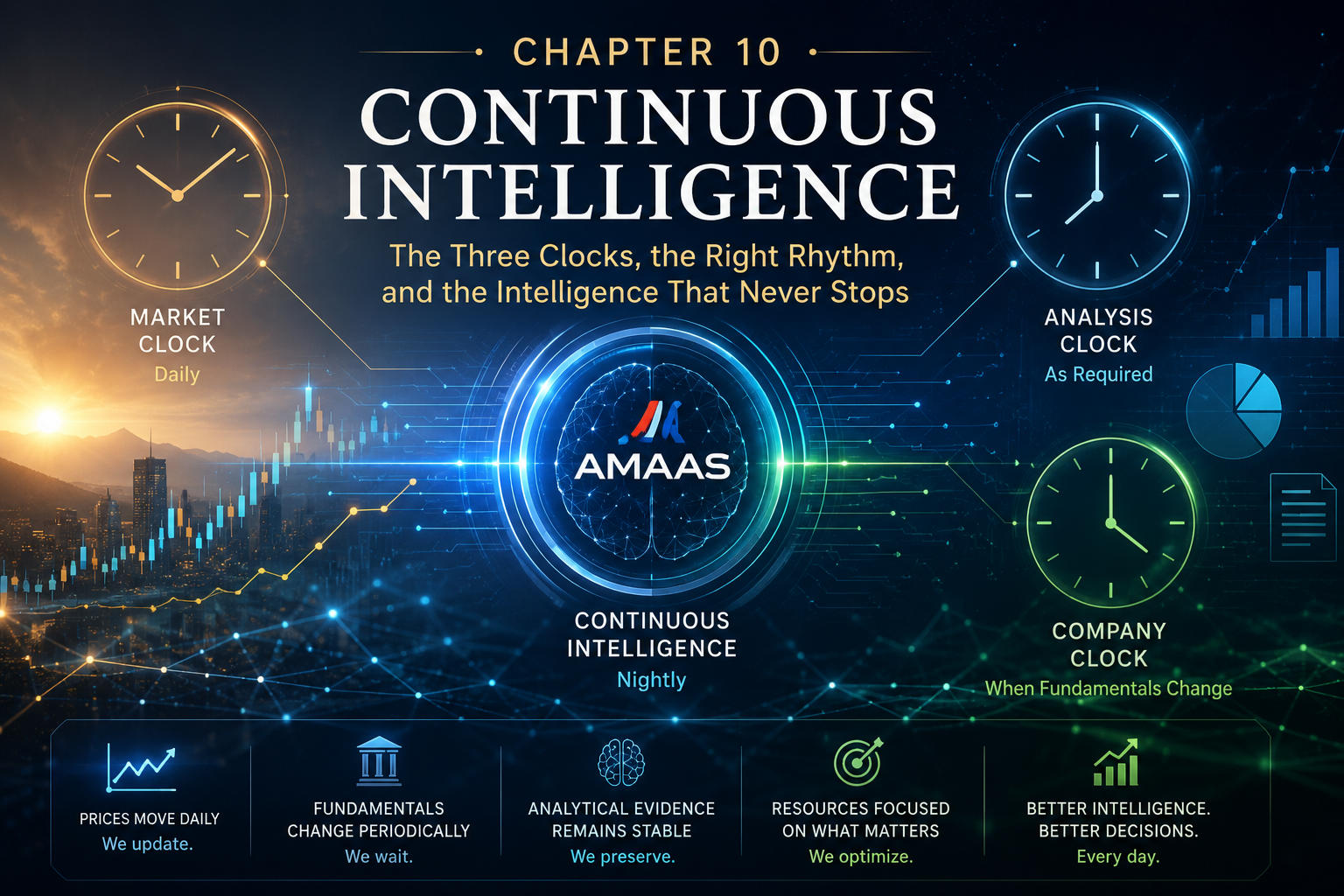
The Three Clocks
First - Analysis:
The analysis clock begins when Generate Alpha runs.
This is the analytical baseline for Company Research, Top 100 selection, AMAAS Chat screening, and universe analysis. A Generate Alpha run on August 11 establishes that date as the new analytical epoch.
Second – Market:
The second clock advances with the market.
Every trading day produces another closing price. The AMAAS price_observation table already contains millions of historical market observations.
By combining the analysis and market clocks we can derive information from what happened between August 11 and September 2. That became the heartbeat of Continuous Intelligence.
Third – User:
A portfolio begins when the user constructs it.
If someone creates a portfolio on September 1, measuring that portfolio from the August 11 analysis baseline would answer the wrong question.
Its natural baseline is September 1. This produced a simple model that clarified a surprising number of design decisions:
Universe Intelligence: Analysis Clock + Market Clock
Portfolio Performance: User Clock + Market Clock
The three-clock analysis model provides clear boundaries among three important sources of knowledge. Analysis clock tells us what AMAAS knew when the analysis was made. The Market Clock tells us what has happened since. The User Clock tells us what happens when an investor entered the picture.
When a Database Becomes Memory
The original AMAAS database already contained an enormous amount of history.
There were company snapshots, dataset runs, millions of price observations, events, jump-model results, forecast outcomes, macro assessments, and the evidence associated with individual analyses.
What it did not contain was a first-class representation of the question:
What was the ranked state of the universe on this particular day, based on this particular analytical baseline?
That required a schema change to support two important concepts: ranking_run and security_ranking_snapshot.
ranking_run describes the analytical event itself. It records things such as: Ranking date, source Generate Alpha run, analysis baseline date, market-data as-of date, ranking methodology/version, qualified universe count, completion status, provenance.
The second table, security_ranking_snapshot, records the state of each security within that run. Its fields include information such as: Baseline price/date, current price/date, growth since analytical baseline, growth percentile, growth rank, 12-month historical growth, momentum percentile, momentum rank, regime state, regime score, regime favorability, financial-quality score, financial-quality percentile, financial-quality rank, forecast score, valuation score, sentiment score, Investment Score, Continuous Score, composite rank, evidence.
There is an important architectural choice hidden in those fields. We do not overwrite yesterday. We add today. If a company's rank changes from 72 to 41 to 19, those are not three revisions to the same fact. They are three facts observed at different times. The database begins to look less like a spreadsheet and more like a journal.
Learning
It is tempting when writing about AI to give machinery human characteristics. AMAAS does not wake up after the closing bell and contemplate the market.
But with surprisingly little automation, something interesting does happen. After the market closes, new price observations enter the database. Those observations change growth calculations. Growth changes percentiles. Percentiles change relative rankings. New financial statements can eventually change financial-quality measurements. Regime changes can alter the interpretation of price behavior. Events can become additional evidence.
The Knowledge Base therefore receives new information without waiting for someone to manually rebuild it. Today's analytical state informs tomorrow. That gives the system a modest form of computational memory:
Observe → Remember → Compare → Recalculate → Rank → Preserve → Explain
This is a useful way to describe autonomous financial intelligence. It has learned, in the engineering sense, how to keep its evidence current.
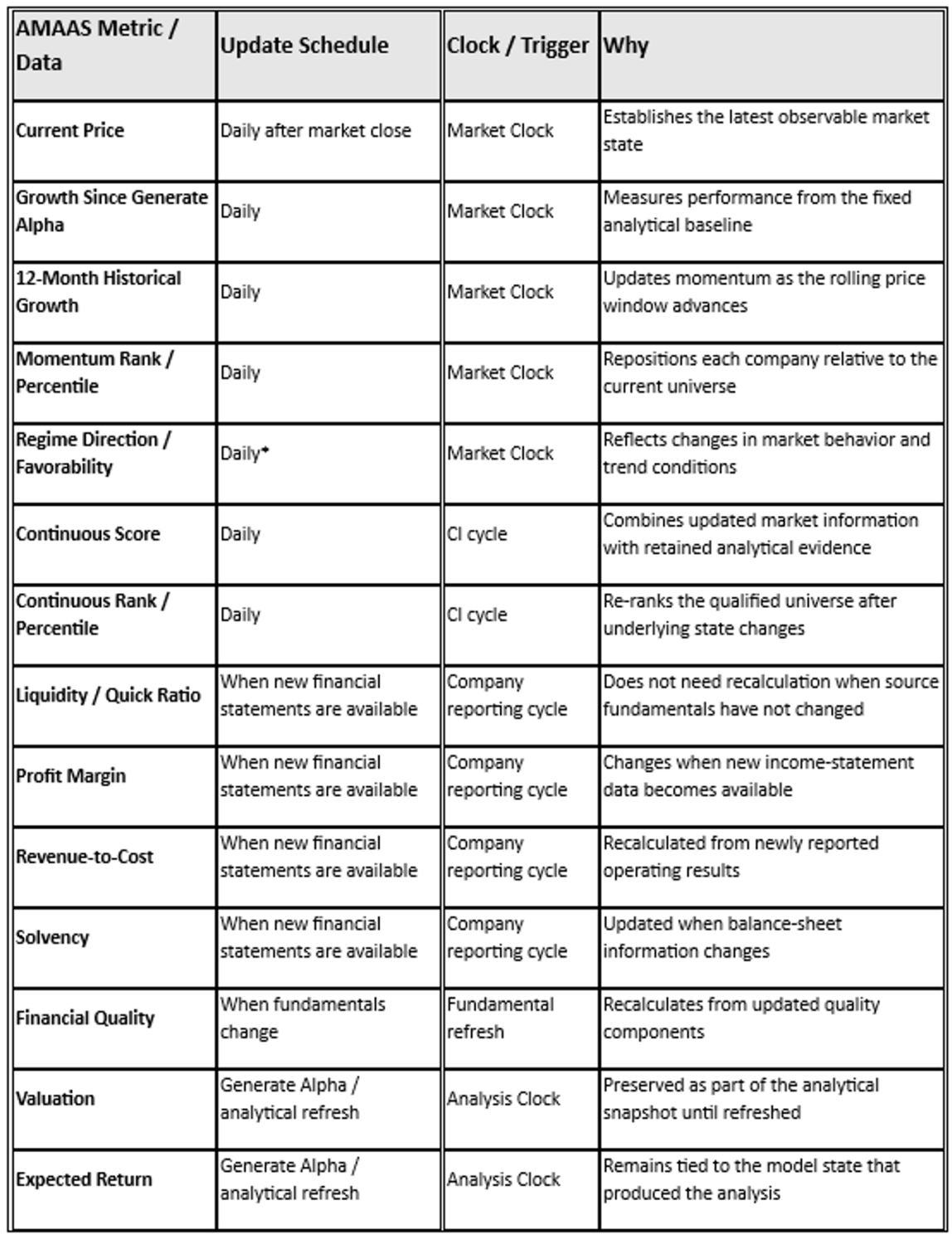
The system updates financial data at different points in time:
Scores First, Rankings Second
Continuous Intelligence also revealed a distinction that had been easy to overlook in a static system. A company's underlying measurement can remain unchanged while its rank changes.
Suppose a company's financial-quality score is 76. Nothing about that company changes overnight. But several competitors report excellent quarters. The company's score might still be 76 while its relative position changes:
Same score. Changing relative position: 81st → 79th → 76th percentile.
The company did not deteriorate. The neighborhood improved. That observation led us toward a cleaner architecture: calculate measurements first; calculate universe-relative rankings second.
For the initial CI pilot, the daily state incorporated four dimensions:
· 35% growth since analytical baseline
· 20% 12-month momentum
· 15% regime favorability
· 30% financial quality
These weights are not presented as some newly discovered law of investing. They are a versioned design choice. That distinction matters because the Continuous Score does not replace the AMAAS Investment Score. It answers a somewhat different question by combining persistent analytical evidence with information that can evolve between full Generate Alpha cycles.
And because the methodology is versioned, we can later examine whether a different weighting scheme would have worked better without pretending that the later formula was the one we used originally.
That is another benefit of treating analytical state as history rather than overwriting it.
Not Everything Needs to Be Recalculated Tonight
One of the opportunities in building an automated system is deciding what needs to change, and when. We could recalculate every financial measure for more than four thousand companies every night.
But financial information does not all change at the same speed. Market prices change daily. Financial statements change periodically. Some analytical evidence should remain stable until new information provides a reason to update it.
Continuous Intelligence requires time aware data designed around market rhythms. Fast-moving market information can be refreshed daily, while fundamental analysis is updated when the underlying financial information changes.
The result is reduction in API traffic and computation, while preserving resources for the new information that matters at that time.
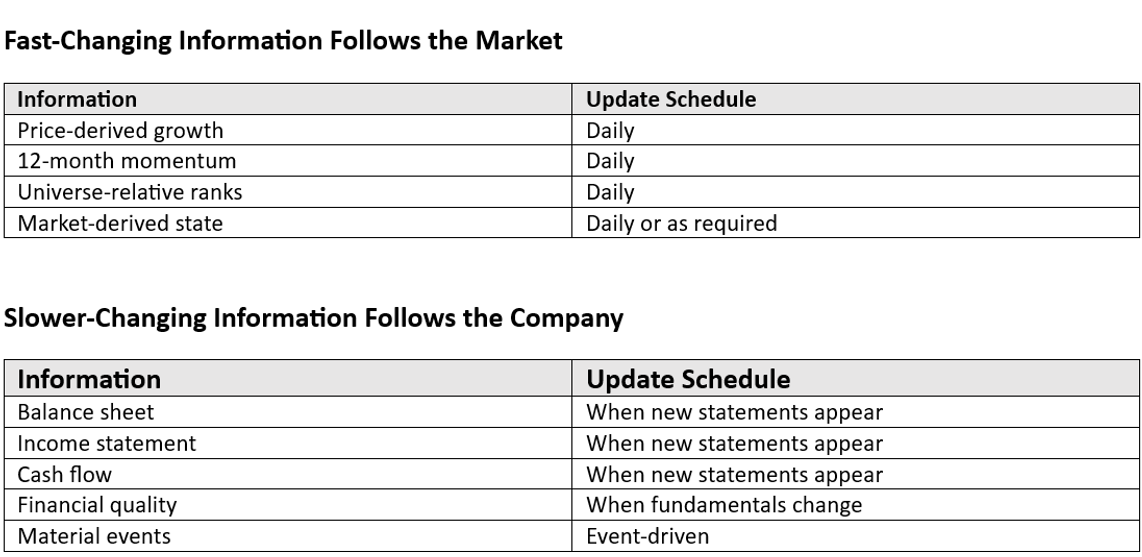
If a company has not filed a new quarter, there is little virtue in repeatedly retrieving the same balance sheet just because the market closed again. The Knowledge Base can retain the existing financial evidence and combine it with today's newer market evidence.
That separation made the system both lighter and, I believe, conceptually better. The world does not update all of its facts at the same frequency.
Neither should the database.
A Bug Can Be an Architectural Review
Two useful discoveries in this project arrived disguised as bugs.
After Continuous Intelligence was running, the web Top 100 still showed the old rankings. At first that seemed like a calculation problem. It wasn't. The CI engine was correctly writing the new rankings to the database. But the public application was still reading the older Generate Alpha path.
We had improved the brain without reconnecting one of the senses. The solution was a change in the way web Top 100 read the latest completed Continuous Intelligence ranking while retaining a Generate Alpha snapshot for deeper research evidence.
That distinction was intentional:
CI determines current membership and relative rank. Generate Alpha continues supplying analytical evidence that should remain tied to the original analysis.
Then the web page worked. The iPhone did not. That led to another layer. The mobile application had its own API route, and the installed version explicitly requests a different sequence in ranking. The server knew the new CI ranking perfectly but the phone politely asked it to reorder those companies according to old criteria.
We added a small compatibility change on the server. Then I opened the iPhone, swiped down, and the Top 100 changed in real time.
The bug had revealed something larger than itself. A continuously updated database is only useful if every interface agrees about the time dimensions of the request.
That lesson will become even more important as agents join the architecture.
Developer/API Subscriptions
API routes initially designed to support an iPhone native interface, enables an opportunity for developers. AMAAS can deliver a differentiated API that exposes derived intelligence: rankings, normalized metrics, regime interpretation, historical analytical state, evidence, and portfolio-relative analysis.
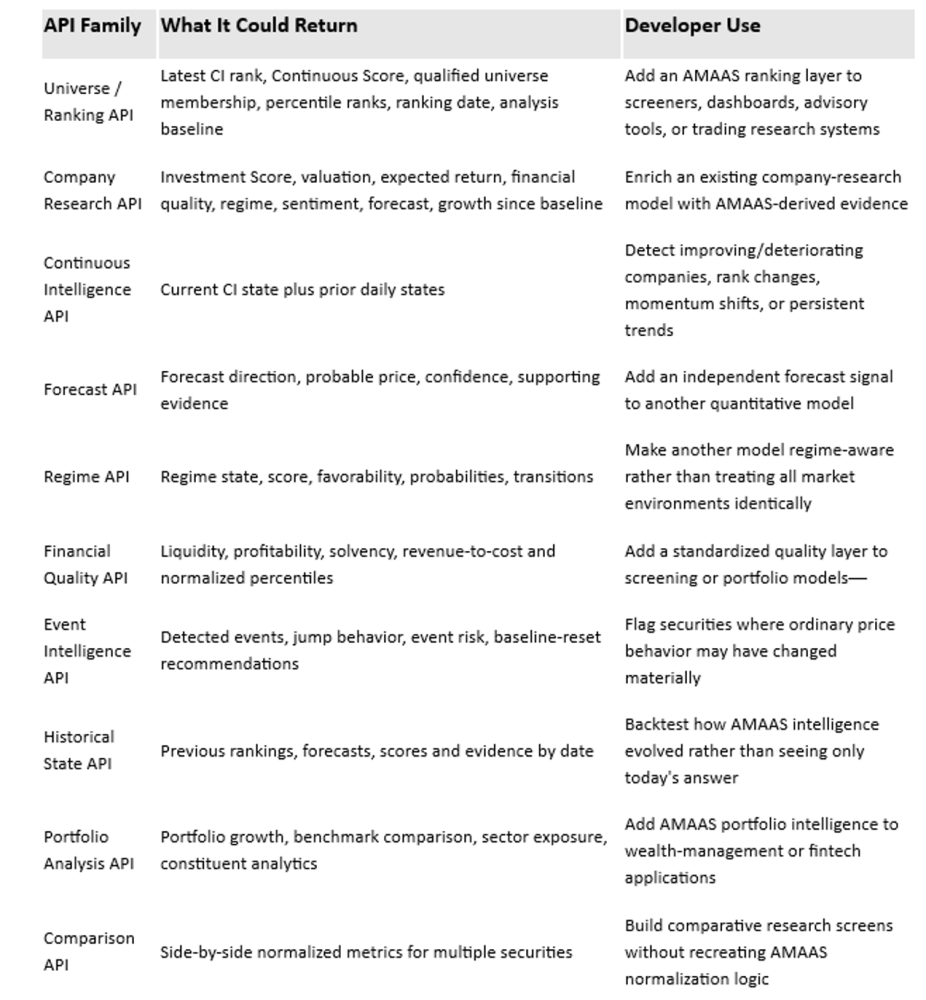
Most APIs tell a developer what a company looks like now. AMAAS could eventually answer a more interesting question:
“What did AMAAS know about this company on August 11, how did that assessment rank against the universe, and what changed afterward?”
From Information to Knowledge History
The architecture that emerged suggests that AMAAS should eventually preserve several parallel histories for each company:
Fundamental history, Price history, Regime history, Baseline history, Event history, Forecast history, Ranking history, Explanation history.
This changes what an AI agent can ask.
Conventional knowledge systems can might answer: What is the financial quality of Company X?
A temporal Knowledge Base can answer:
Which financial quality signals changed in the last week, month, or year?
Its fundamentals have remained stable. Why has its AMAAS rank fallen?
Which companies have improved their ranking for ten trading sessions without a corresponding increase in valuation risk?
What changed since the last time we looked at this company?
That last question may be one of the most natural forms of human-machine financial analysis. Humans are good at asking the right questions. Computers are good at remembering enough detail to answer it.
AI Agents
The agent should not receive a question and then calculate four thousand stocks. Most of that work has already happened. By the time a user asks a question, the platform should know:
what the latest completed analytical state is,
what changed,
when it changed,
which analytical baseline applies,
how companies compare with one another,
what evidence produced the ranking,
and whether the newest state passed validation.
The agent's job then becomes much more interesting.
It can reason over the evidence, explain, compare, and notice contradictions. It can help a person understand why a company that looked attractive three weeks ago has moved down the list even though nothing obviously bad happened to the company itself.
That is closer to the human-machine relationship I have been trying to build throughout AMAAS. The machine remembers millions of observations. The financial analyst decides which questions are worth asking.
The Database Has a Past
Database schema changes are rarely described poetically.
A new table is still a new table.
A foreign key remains a foreign key.
And somewhere beneath everything described in this chapter are SQL statements doing exactly what SQL statements have done for decades.
But architecture sometimes changes the character of a system.
Generate Alpha gave us analytical snapshots.
The market gave us a stream of new observations.
The new schema gave us a way to connect the two without destroying either.
Automation gave the process rhythm.
Validation gave it restraint.
History gave it accountability.
And the Knowledge Base gained something that static knowledge bases do not naturally possess: a past.
That past makes change measurable.
Measured change makes adaptation possible.
And adaptation gives the AI layer something much richer to work with than a collection of current values.
It gives it a story.
For a financial-analysis platform, that may be particularly important because markets themselves are stories told through time. Prices change. Companies report. Expectations move. Models are revised. Some forecasts work. Others do not. An observation that was reasonable in August may look very different in December.
The objective is not to make AMAAS predict every turn correctly.
It is to build a system capable of remembering what it knew, recognizing what has changed, incorporating new evidence, and helping us understand the difference.
And sometimes all of that engineering becomes visible in the simplest possible way.
You swipe down on the phone.
The list changes.
The system has another day to remember.
Disclaimer: This article is provided for educational and informational purposes only and does not constitute investment advice, a recommendation, or an offer to buy or sell any security. AMAAS analytical scores, rankings, forecasts, and model outputs are quantitative research tools and should not be relied upon as guarantees of future performance. Investing involves risk, including the possible loss of principal. Past performance does not guarantee future results.
Continuous Intelligence describes AMAAS's process for incorporating new data into its analytical framework; it does not imply autonomous decision-making or guaranteed improvement in investment outcomes.
#AMAAS #ContinuousIntelligence #FinTech #InvestmentResearch #HumanMachinePartnership